
What Hidden Costs Are Killing Your HVAC Scaling Efforts, and How AI Dispatchers Fix Them - Marketing Masters
You crossed $1M in revenue. Trucks are running. Phones are ringing. By every surface metric, things look good.
But somewhere between $1M and $3M, growth starts to feel like running uphill in wet boots. You're working 11-14-hour days, reinvesting every dollar back into the business, and still watching your margins shrink. The culprit isn't the market. It isn't your techs. It's the invisible operational drag that multiplies as you scale, and most owners don't spot it until it's already cost them six figures.
Scaling HVAC firms lose 20-30% of potential bookings to inefficiencies that could be fixed with the right systems. AI dispatchers are closing that gap fast. This article breaks down exactly what's eating your profits and how intelligent automation stops the bleeding for multi-million dollar operations.
The Hidden Costs Most $1M+ HVAC Owners Never Track
The problems don't announce themselves. They accumulate quietly in your overhead line, your callback rate, and your dispatcher's daily chaos.
Routing and Dispatch Inefficiency
Multi-crew operations bleed money through poor tech assignments. On average, techs in growing fleets waste 30-40% of their working hours on suboptimal routes, wrong tech for the job, wrong location sequencing, and unnecessary drive time. At $60K+ per truck in annual fuel and labor costs, that's not a rounding error. It's a structural leak.
Admin Overload and Missed Calls
Manual scheduling consumes 10-20 hours per week per dispatcher. That same dispatcher is also triaging inbound calls, updating job statuses, and chasing ETAs. When volume spikes, peak season, emergency calls, and after-hours demand occur, the system breaks. Roughly 40% of calls go unanswered during overload windows. Every missed call is a missed booking. At $300-500 per average HVAC job, a 40% miss rate during peak hours is thousands of dollars evaporating daily.
Pricing Erosion from Legacy Systems
Labor costs are up 20% industry-wide. Materials fluctuate. But most $1M+ operations still price jobs using the same flat-rate books or gut-feel estimates they used at $400K. The result: 6-15% margin erosion on high-value service calls, with install and service jobs averaged together in ways that consistently undervalue the more profitable work. One Reddit thread in r/HVAC captured this precisely: owners confusing gross margin with break-even, scaling volume without ever stabilizing per-job profitability.
Hiring and Training Bottlenecks
First-year tech failures run close to 70%, not because of technical gaps, but because of skill-job mismatches and sales deficiencies that dispatch never accounts for. Each failed hire costs $20K-50K in lost productivity, onboarding time, and callback rework. As you push toward $5M, this problem compounds. Specialists outperform generalists, but most dispatch systems have no mechanism to match job type to tech expertise.
Inventory and Callback Waste
Poor inventory management ties up $10K-30K in capital sitting on trucks or in warehouses. Callback rates of 20-30% drain another $15K-40K per site annually. One $150M home performance firm documented losing money for their first several years of HVAC expansion, almost entirely due to callbacks and return trips that preventable systems should have eliminated.
Hidden Costs: Impact for $1M+ Firms
Here is the breakdown of the hidden costs, their operational impact, and the resulting annual financial drain:
Routing inefficiency: Causes poor tech-to-job matching across growing fleets (Annual Drain: $60K+ per truck).
Admin overload: Leads to manual scheduling bottlenecks without automation support (Annual Drain: $50K-$100K in lost productivity).
Pricing erosion: Relies on legacy flat-rate systems that miss margin opportunities (Annual Drain: $60K-$150K in margin leakage).
Hiring failures: Results in mismatched job assignments that drive early turnover (Annual Drain: $20K-$50K per tech).
Callbacks and inventory waste: Creates rework, excess stock, and unnecessary return trips (Annual Drain: $15K-$40K per site).
How much of this is showing up in your numbers right now?
What Happens When You Ignore These Costs
None of these problems stays contained. They cascade.
Inefficient routing leads to higher overtime. Higher overtime burns out techs. Burned-out techs generate more callbacks. More callbacks erode client trust. Lost client trust kills repeat business and referrals. The cycle is self-reinforcing, and it gets worse as revenue grows because every inefficiency now operates at a greater scale.
Revenue leaks accelerate at $2M+. After-hours lead loss alone runs at 30% for firms without 24/7 coverage. Combined with callback rates and unbookable calls during peak overflow, operations at the $2-3M mark often hemorrhage $200K-500K annually in recoverable revenue. That money isn't gone because the demand isn't there. It's gone because the system couldn't handle it.
Owner burnout becomes a ceiling. The path from $1.7M to $5.8M is brutal without process automation. Operators who've walked it describe it as "brain damage", working more hours than ever, paying themselves less, watching their margins erode as team size grows. When the owner is still the operational bottleneck at $3M, the business cannot scale past $3M. It's structurally impossible.
Competitors with faster systems win the job. Response time determines booking rate. When a competitor with automated dispatch can confirm a booking in minutes, and you're calling back two hours later, the client has already moved on. With labor costs rising 20% across the industry, slower operations also absorb more cost per job, a compounding disadvantage as the market tightens.
What if these effects have already capped your ceiling at $5M when your operation should be capable of $10M+?
Why AI Dispatchers Are Now an Operational Requirement, Not a Bonus Feature
Patching the problem with more dispatchers doesn't work. You add headcount, add overhead, and recreate the same manual bottlenecks at a higher cost. The shift that actually breaks the cycle is intelligent automation built for $1M+ operational complexity.
Real-Time Routing and Scheduling Optimization
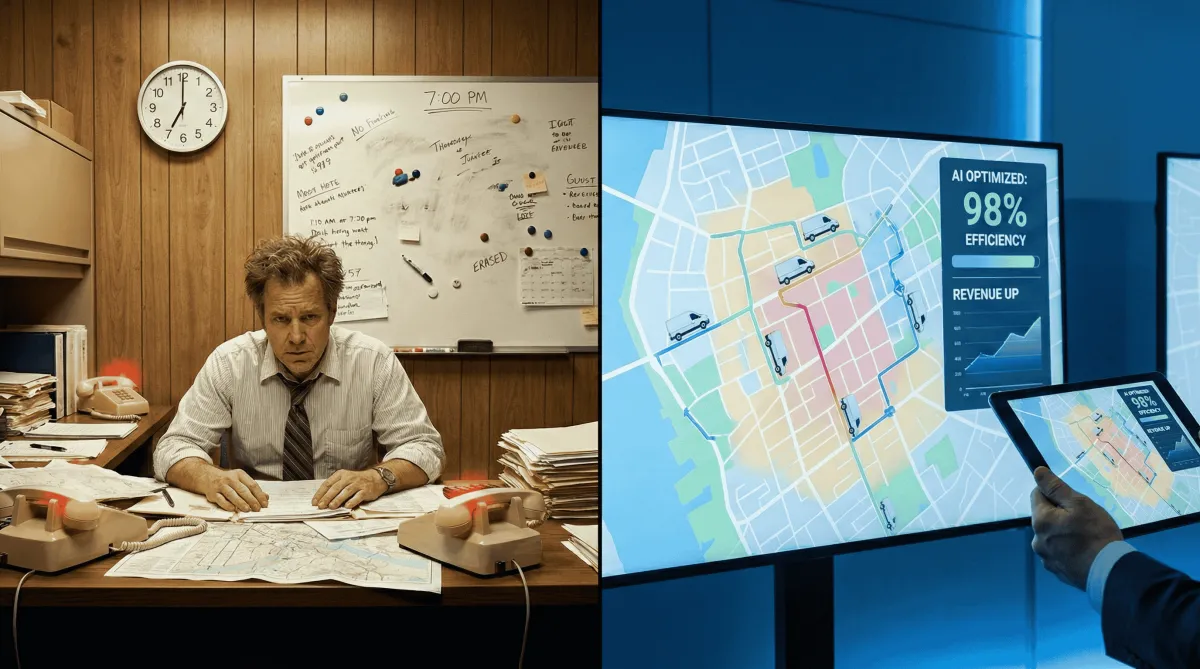
AI dispatch systems predict traffic patterns, match tech certifications to job requirements, and dynamically resequence routes throughout the day. This isn't scheduling software with a better interface; it's a system that continuously recalculates optimal assignments as conditions change. The result is 20-30% route efficiency improvement and a meaningful reduction in overtime costs.
For after-hours volume, AI handles 24/7 inbound call triage without a human dispatcher. Calls get qualified, jobs get categorized by urgency, and techs get dispatched, while your competitors' phones ring to voicemail.
Automation That Frees 10-20 Hours Per Week
AI dispatcher systems integrated with platforms like ServiceTitan handle lead qualification, ETA updates, customer notifications, and status tracking automatically. That's 10-20 hours per dispatcher per week returned to higher-value activity. One operation documented cutting job triage time from 45 minutes to 3 minutes after implementation, with the same throughput, and a fraction of the labor cost.
Operators who previously spent $40K annually on operations consultants have replaced that function with AI-built dispatch workflows. The savings compound immediately.
Data-Driven Pricing and Inventory Sync
AI systems pull real-time labor and materials data to generate accurate quotes instead of relying on static rate books. For $1M+ operations where a single underbid on a large install job can wipe out a week of profit, this isn't a convenience feature. It's margin protection at scale. Integrated inventory management also eliminates the capital tied up in overstocked trucks and catches parts shortages before they trigger a return trip.
Scalable Hiring Support
When dispatch intelligently matches job type to tech skill profile, first-year failure rates drop. Techs stop getting assigned to jobs that expose their weak spots. Callbacks decrease. Client satisfaction scores rise. The compounding effect: you retain more techs, reduce re-hire costs, and build a more capable crew without proportionally increasing your headcount.
What specific capability gap in your current dispatch system is costing you the most right now?
The Payoff: What AI Dispatch Actually Delivers for $1M+ Operations
The numbers are documented across real operator implementations.
Route optimization alone generates 15-20% more revenue per tech. One firm moved from 145 jobs per month to 204 after-hours bookings after implementing AI scheduling, a 41% increase from the same tech base. No new hires. No expanded territory. Just a smarter system filling gaps that the manual process was missing.
Route optimization: Drives 15-20% more revenue per technician (Documented result: increased from 145 to 204 jobs per month).
Admin automation: Generates $50K-$100K in annual labor savings (Documented result: triage time cut from 45 minutes down to just 3 minutes).
24/7 inbound coverage: Recovers 30% of previously lost after-hours leads (Documented result: achieved a 90% booking rate on after-hours calls).
Pricing integration: Delivers 6-15% margin stabilization (Documented result: eliminated a $40K dependency on outside consultants).
Callback reduction: Saves $15K-$40K per site (Documented result: saw an 80% drop in "where are you?" customer calls).
Across these categories, $1M+ operations are recovering $200K-500K annually in revenue that was previously leaking through manual process gaps.
The ownership shift is equally significant. When AI handles dispatch triage, scheduling, customer updates, and after-hours calls, the owner stops being an operational firefighter. That bandwidth goes into growth strategy, key account relationships, and the decisions that actually move a business from $3M to $10M. One documented AI dispatch implementation generated $331K in annual value by eliminating human labor from routine dispatch functions, without reducing service quality.
Long-term, operations running AI dispatch have a structural advantage as they push toward $10M-150M in revenue. Lower overhead per job. Faster response times. Higher booking rates. Better tech retention. These aren't marginal gains; they're the difference between stalling at $5M and continuing to build.
The Scaling Reality for HVAC Operators
Hitting $1M proved you can run an HVAC business. Scaling past $5M requires something different, systems that perform consistently without your direct involvement at every step.
The hidden costs outlined here aren't unique to struggling operations. They show up in nearly every $1M-$3M HVAC firm because manual processes that worked at $500K simply break under higher volume. The owners who push past this wall aren't working harder. They're operating differently, with automation handling the repetitive, time-sensitive functions that used to require a dispatcher at a desk.
AI dispatch is not a distant technology. It's running in HVAC operations today, and the competitive gap between firms using it and firms still running manual systems is widening every quarter.
The question isn't whether to implement it. It's whether you move before your local competitors do.
Apply for Enterprise AI Automation Optimization - Qualified Operations Only
Marketing Masters works exclusively with established HVAC and trades operations ready to scale through systematic automation. Our team has deployed AI dispatcher systems, multi-crew coordination workflows, and GoHighLevel-integrated automation for operations at $1M through $10M+ in annual revenue. We've cut dispatch overhead, recovered after-hours revenue, and built automated pipelines that stabilize margins during high-growth phases.
We only accept businesses generating $1M+ annual revenue that demonstrate readiness for enterprise-level implementation. If approved, you qualify for a complimentary business assessment where we analyze your current dispatch process, identify your highest-cost operational gaps, and map exactly how AI automation integrates with your existing systems.
Qualification requirements: $1M+ verified annual revenue, multi-crew or multi-site operations, demonstrated commitment to systematic growth.
Call 763-325-9378 or submit your application at: https://marketingmasters.me/business-assessment-application